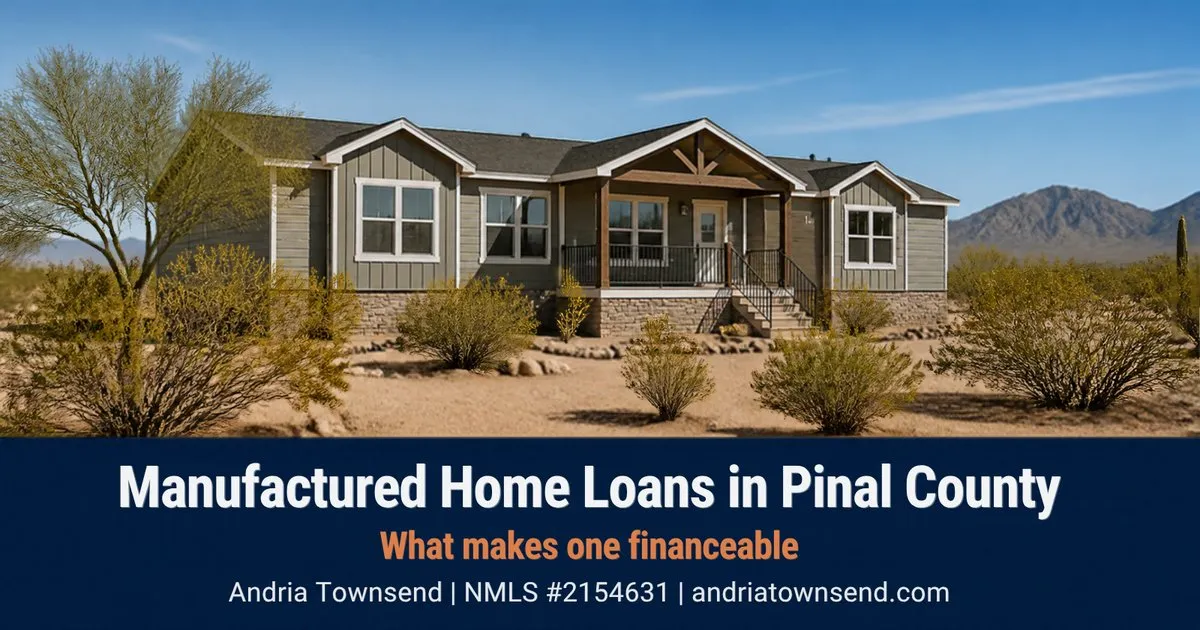
Manufactured Home Loans in Pinal County: What Makes One Financeable
Quick answer
A manufactured home loan in Pinal County works much like a regular mortgage when the home and the land are financed together as real property. Lenders want a home built to the federal HUD code (June 15, 1976 or later) with its HUD label or data plate, set on a permanent foundation with the towing hitch, wheels and axles removed. In Arizona, an affidavit of affixture recorded with the county moves the home off its vehicle-style title so it's assessed as real property. Homes on rented lots and homes moved from another site have the fewest loan options.
A manufactured home loan in Pinal County is very doable, but the home has to check a few boxes that a site-built house never deals with. If you're looking at a manufactured home on acreage near Florence, Coolidge or Arizona City, here's what makes one financeable, which loan types allow it, and the Arizona paperwork that ties the home to the land.
Can I get a mortgage on a manufactured home in Pinal County?
Yes. Conventional (Fannie Mae), FHA, VA and USDA loans can all be used on a manufactured home when it meets the program's rules. The key idea is simple: the loan covers the home and the land together, and both are treated as real estate. If the home sits on a lot you rent, or it's still titled like a vehicle, the options change a lot.
What makes a manufactured home financeable?
Each program has its own list, but these items show up again and again:
| What lenders check | Why it matters |
|---|---|
| Built to the HUD code | Fannie Mae requires a home built to the federal construction and safety standards that took effect June 15, 1976. Older "mobile homes" don't qualify. |
| HUD Certification Label or HUD Data Plate | This is the proof it meets the HUD code. Fannie Mae accepts an alternative, such as a label verification letter, if the originals are missing. |
| Permanent foundation | The home must be attached to a permanent foundation system that fits the site's soil and meets state and local codes. |
| Hitch, wheels and axles removed | Fannie Mae and USDA require it, and so does FHA for newer installs. |
| Size | At least 400 square feet for Fannie Mae and FHA (and USDA, for new homes). Fannie Mae also sets a minimum width of 12 feet. |
| Real property | The home and land must be legally classified as real property, with one mortgage covering both. |
How do conventional, FHA, VA and USDA rules compare?
Conventional (Fannie Mae). Fannie Mae's Selling Guide (B5-2-02) allows single-width and multi-width homes as a primary residence, and multi-width homes as a second home. Investment properties aren't eligible. A home on leased land is only eligible inside a condo or PUD project Fannie Mae has approved. Fannie Mae also has MH Advantage, for homes built to standards closer to site-built houses, like a masonry or poured concrete perimeter foundation, a covered porch and gutters.
FHA. Under 24 CFR 203.43f, the home must be a one-family manufactured home of at least 400 square feet, built to the HUD standards with a certification label, and the property must be classified and taxed as real estate. If the home has been on its site for more than a year, it must be anchored to permanent footings, have permanently installed utilities and a properly enclosed crawl space, and it must only have been occupied at that location. Newer installs need a permanent foundation that meets HUD's standards. See FHA loans in Arizona.
VA. VA.gov lists buying a manufactured home or lot as an eligible use of a VA-backed purchase loan. I'll check VA's property rules for the specific home.
USDA. Under 7 CFR 3555.208, an existing home must have both a HUD Certification label and a HUD Data Plate, sit on a permanent foundation with a foundation certification, and never have been installed on another homesite. USDA won't finance an existing home that was moved from another site. The loan must cover the home and the land, and the home must be taxed as real estate. See USDA loans in Arizona.
What is an affidavit of affixture in Arizona?
In Arizona, a manufactured home starts out with a title from the Department of Transportation, like a vehicle. An affidavit of affixture is how it becomes part of the real estate.
- Who can file. Under A.R.S. 42-15203, someone who owns a mobile home that's permanently affixed to real property may record an affidavit of affixture with the county recorder. A.R.S. 42-15201 defines "permanently affixed" as installed on land owned by the home's owner.
- What's in it. The home's vehicle identification numbers, the land's legal description, its personal property tax history, any lienholders that haven't released their interest, and the Department of Transportation's receipt.
- The title. A.R.S. 28-2063 says the owner surrenders the original certificate of title (or manufacturer's statement of origin), and the department issues a receipt.
- Taxes. Under A.R.S. 42-15202, once the affidavit is recorded, the home is assessed as real property.
- Homes from out of state. A home entering Arizona for sale or installation needs a certificate of compliance or waiver from the Arizona Department of Housing when the affidavit is recorded.
Ask the title company early whether an affidavit is already on record. If it isn't, plan time for it so the home and land can be financed together as real property.
Can I finance a manufactured home in a park or on leased land?
It's much harder. Arizona does allow an affidavit of affixture for a home in a mobile home park under A.R.S. 33-1501, but only if the wheels and axles are removed, the home is installed to state and local standards, the lease has a primary term of at least 20 years and allows the affidavit, and a memorandum of lease is recorded first. Even then, Fannie Mae only buys loans on leased land in an approved condo or PUD project. A park home that isn't real property needs a different kind of loan, often called a personal property or chattel loan, which this post doesn't cover.
What should I check before making an offer?
- Find the HUD label and data plate. There's a certification label on each section at the tail-light end, and the data plate is inside the home. Take photos.
- Ask if the home was ever moved. A home moved from another site rules out USDA and can be a problem for FHA.
- Get the title status. Is there a recorded affidavit of affixture, or is the home still on a vehicle title?
- Plan for a foundation certification. USDA requires a foundation certification, and other loans may ask for one too. Check what the seller already has.
- Look at the water and septic. Many manufactured homes on acreage use a well and septic. See my posts on private wells in Pinal County and septic inspections in Pinal County.
My Pinal County mortgage page covers the loan options I offer locally.
Frequently asked questions
Can I get an FHA loan on a manufactured home in Arizona?
Yes, if the home and land are financed together and the property is classified and taxed as real estate. Under 24 CFR 203.43f, the home must be at least 400 square feet, built to HUD's manufactured home standards with a certification label, and installed on a foundation that meets HUD's rules.
Does a manufactured home have to be built after 1976 to get a mortgage?
For the major loan programs, yes. Fannie Mae requires a home built to the federal manufactured home standards that took effect June 15, 1976, shown by a HUD Certification Label or HUD Data Plate.
What is an affidavit of affixture in Arizona?
It's a document recorded with the county recorder that ties a manufactured home to the land it sits on. The owner surrenders the vehicle-style title to the Department of Transportation, and under A.R.S. 42-15202 the home is then assessed as real property.
Can I use a USDA loan on a used manufactured home?
Sometimes. Under 7 CFR 3555.208, an existing home must have a HUD Certification label and HUD Data Plate, sit on a certified permanent foundation, and never have been installed on another homesite. USDA won't finance a home that was moved from another site.
Can I get a conventional loan on a single-wide manufactured home?
Yes, as a primary residence. Fannie Mae's Selling Guide allows single-width homes for a primary residence, but only multi-width homes for a second home. Fannie Mae's minimum width is 12 feet.
Can I get a mortgage on a manufactured home in a mobile home park?
It's limited. Fannie Mae only allows homes on leased land in an approved condo or PUD project. Arizona law lets park homes record an affidavit of affixture under strict lease conditions. A park home that isn't real property needs a different kind of loan.
Details come from the Fannie Mae Selling Guide, the Code of Federal Regulations, the Arizona Revised Statutes and VA.gov, all read November 2, 2026. Your loan program, the county and the home's records control the details for your purchase. This isn't legal advice.
Looking at a manufactured home in Pinal County?
Send me the listing and I'll tell you what your loan program will need for that home and land, before you're deep into escrow. No pressure.
Get pre-approved or ask Andria a question at andriatownsend.com or call 480-487-9166.
About the author: Andria Townsend is a Mortgage Loan Originator with NEXA Mortgage, LLC, based in San Tan Valley, Pinal County. She's lived in Arizona for 15+ years and helps buyers and homeowners across the state.
Andria Townsend, Mortgage Loan Originator, NMLS #2154631. NEXA Mortgage, LLC, NMLS #1660690. Equal Housing Opportunity. This is not a commitment to lend. All loans subject to credit approval, underwriting, and program guidelines.
Sources
- Fannie Mae Selling Guide B5-2-02: Manufactured Housing Loan Eligibility
- Fannie Mae Selling Guide B2-3-02: Factory-Built Housing
- 24 CFR 203.43f: FHA eligibility of mortgages covering manufactured homes
- 7 CFR 3555.208: USDA special requirements for manufactured housing
- VA.gov: VA-backed purchase loan
- A.R.S. 42-15201: Definitions (permanently affixed)
- A.R.S. 42-15202: Assessment of permanently affixed mobile homes as real property
- A.R.S. 42-15203: Affidavit of affixture
- A.R.S. 28-2063: Mobile home certificate of title
- A.R.S. 33-1501: Affidavit of affixture for mobile home in mobile home park