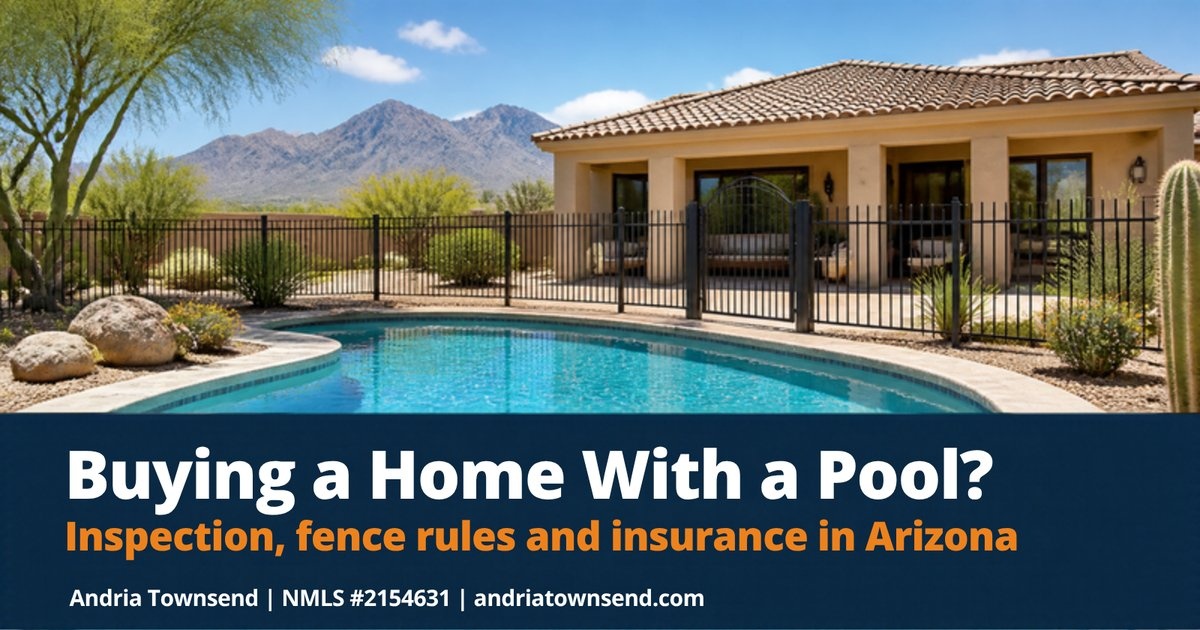
Buying a Home With a Pool in Arizona: Inspection and Insurance
Quick answer
What should you check when buying a home with a pool in Arizona? Get the pool inspected on its own, since Arizona home inspectors aren't required to include it. Look at the fence and gates against state law and your city or county code. Expect the seller to hand you the state's pool safety notice. Tell your insurance agent about the pool before you pick a policy. On an FHA loan, the appraiser also reports pool problems, and the pool has to meet local rules.
Buying a home with a pool in Arizona is common, and a pool can be a big part of why a house fits you. It also adds a few steps to your purchase: a separate inspection, a look at the fence, a state notice, and a conversation with your insurance agent. Here's how each one works and where the loan fits in.
Does a home inspection in Arizona include the pool?
Not automatically. Arizona's rules for certified home inspectors (Ariz. Admin. Code R4-30-301.01) say an inspector is not required to inspect a pool or spa as part of a home inspection. If the inspector does inspect it, they have to follow the Arizona Home Inspector Pools and Spas Standards of Professional Practice the Board of Technical Registration adopted in April 2023.
So when you book your inspection, ask two questions:
- Is the pool and spa included, or is it an add-on?
- Will the report cover the equipment too? Pumps, filters, heaters, the automatic cleaner, the electrical bonding and the barrier around the pool.
Some buyers also bring in a separate pool company to look at the surface, the plumbing and the equipment. That's your call. Either way, get it done inside your inspection period so you still have time to ask the seller for repairs or credits.
What are Arizona's pool fence rules?
Arizona's pool enclosure law, A.R.S. 36-1681, covers pools and other contained bodies of water that are 18 inches or deeper at any point, wider than 8 feet at any point, and meant for swimming. Where the state law applies, the main rules are:
| Part of the barrier | State rule (A.R.S. 36-1681) |
|---|---|
| Height | At least 5 feet, measured on the outside |
| Openings | Nothing a 4-inch ball can pass through; no handholds or footholds on the outside |
| Distance from the water | At least 20 inches from the water's edge |
| Gates | Open outward from the pool, self-closing and self-latching, latch at least 54 inches high (or on the pool side, or keyed) |
| House as part of the barrier | Needs one option: a 4-foot fence between house and pool, a key-switch motorized safety cover, or self-latching doors and window latches that meet the statute |
Cities and counties can adopt their own pool barrier codes, as long as they're at least as strict as the state law, and the state law has exceptions, including pools built before it took effect. That means the rule for your house depends on where it is. For example, Maricopa County's code for unincorporated areas requires a permit for a pool barrier before the pool is plastered or filled, and lists alarm specs for doors that open to the pool area. If you're buying in a city or town, check that city's building department.
What is the Arizona pool safety notice?
Under A.R.S. 36-1681(E), anyone who sells, rents or leases a home with a pool has to give the buyer or renter a notice about pool safety and the responsibilities of pool ownership, approved by the Arizona Department of Health Services (ADHS). The ADHS Residential Pool Safety Notice lists the barrier and gate rules and its recommendations, such as checking gate latches regularly, never propping a gate open, and moving anything that could be used to climb the barrier.
Read it, keep it, and if you don't get one, ask your agent. It's a good checklist to walk the yard with on your final walkthrough.
Does a pool affect my FHA loan or appraisal?
For an FHA loan, it can. HUD's Single Family Housing Policy Handbook (4000.1) says:
- The lender has to confirm any swimming pool complies with all local ordinances.
- The appraiser has to report readily observable defects that would make a pool inoperable or unusable.
- Green or algae-filled water alone doesn't require cleaning if there's no other sign the pool is contaminated.
- A pool has to be operational to add its full value to the appraisal.
- If a pool has unstable sides or structural problems, the appraiser has to make the appraisal subject to repairing it or permanently filling it in under local rules.
Conventional, VA and USDA loans have their own property standards. I'll check the specific rules for the loan you're using before you write an offer. See my FHA loans in Arizona page for more on how FHA works.
Can I finance pool repairs with my mortgage?
Sometimes. HUD's 203(k) rehabilitation program lets you roll certain repairs into an FHA purchase loan. The handbook lists repairing or removing an existing in-ground pool as an eligible item, but new swimming pools are not eligible. My renovation loans page covers how these loans work. For smaller fixes, many buyers ask the seller to make the repair before closing or give a credit instead.
How does a pool affect homeowners insurance in Arizona?
The Arizona Department of Insurance and Financial Institutions (DIFI) says homeowners insurance covers damage to your home and also offers protection against liability for accidents that injure other people or damage their property. DIFI also encourages homeowners to talk with their agent about the risks an insurer looks at when it decides whether to write a policy and what to charge.
With a pool, that means:
- Tell the agent about the pool, plus any spa, slide or diving board, before you get quotes.
- Ask about personal liability and medical payments limits. DIFI describes medical payments coverage as paying reasonable expenses for others hurt on your property, regardless of fault.
- Ask what the insurer requires, such as a fence or locked gate.
- Remember insurance isn't a home warranty. DIFI notes insurance covers sudden, accidental damage, while home warranties cover things that wear out, so a worn-out pool pump usually isn't an insurance claim.
Shop insurance early. Your lender needs proof of coverage before closing, and the premium is part of your monthly housing cost. If you're comparing homes in the Phoenix area, my post on home insurance costs in Maricopa County walks through how insurance affects what you can afford.
What should I do before making an offer on a home with a pool?
- Book a home inspection that includes the pool and spa, or add a separate pool inspection.
- Walk the fence and gates and check them against the local code.
- Ask the seller for the age of the pool equipment and any repair records.
- Get an insurance quote with the pool listed.
- Tell me about the pool up front so we pick the right loan and plan for the appraisal.
Buying in San Tan Valley or nearby? See my San Tan Valley home loans page.
Frequently asked questions
Do Arizona home inspectors have to inspect the pool?
No. Arizona's rules say a certified home inspector isn't required to inspect a pool or spa. If they do, they have to follow the state's Pools and Spas Standards of Professional Practice. Ask whether the pool is included when you book.
How high does a pool fence have to be in Arizona?
Under A.R.S. 36-1681, the barrier has to be at least 5 feet high, measured on the outside, and at least 20 inches from the water's edge. Cities and counties can have stricter codes, so check the local rule for the address.
Does the seller have to give me a pool safety notice?
Yes. Arizona law requires a person selling, renting or leasing a home with a pool to give the buyer or renter a pool safety notice approved by the Arizona Department of Health Services.
Can I get an FHA loan on a house with a pool?
Yes. FHA requires the pool to comply with local ordinances, and the appraiser reports defects that make it unusable. If the pool has unstable sides or structural problems, the appraisal is made subject to repairing it or permanently filling it in.
Does a pool change my homeowners insurance?
It can. Insurers look at risks like a pool when they decide whether to write a policy and what to charge. Tell your agent about the pool and ask about liability and medical payments limits before you choose a policy.
Can I add a new pool with an FHA 203(k) loan?
No. HUD's handbook lists new swimming pools as ineligible for 203(k) financing. Repairing or removing an existing in-ground pool is eligible.
Details come from A.R.S. 36-1681, Ariz. Admin. Code R4-30-301.01, the Arizona Department of Health Services Residential Pool Safety Notice, Maricopa County Planning and Development, HUD Handbook 4000.1 and the Arizona Department of Insurance and Financial Institutions, all read November 13, 2026; key sources rechecked November 16, 2026. Local pool codes vary, so confirm the rule for a specific address with the city or county. This isn't legal or insurance advice.
Thinking about a home with a pool?
Send me the address and I'll help you figure out what the insurance and taxes add to your monthly cost, and which loan fits the house. No pressure.
Get pre-approved or ask Andria a question at andriatownsend.com or call 480-487-9166.
About the author: Andria Townsend is a Mortgage Loan Originator with NEXA Mortgage, LLC, based in San Tan Valley, Pinal County. She's lived in Arizona for 15+ years and helps buyers and homeowners across the state.
Andria Townsend, Mortgage Loan Originator, NMLS #2154631. NEXA Mortgage, LLC, NMLS #1660690. Equal Housing Opportunity. This is not a commitment to lend. All loans subject to credit approval, underwriting, and program guidelines.
Sources
- A.R.S. 36-1681: Pool enclosures; requirements; exceptions; enforcement
- Ariz. Admin. Code R4-30-301.01: Home Inspector Rules of Professional Conduct
- Arizona Department of Health Services: Residential Pool Safety Notice
- Maricopa County: Residential Pool and Barrier Requirements
- HUD Handbook 4000.1, Single Family Housing Policy Handbook (Swimming Pools; 203(k) eligible and ineligible improvements)
- Arizona DIFI: Homeowners Insurance consumer information
- Arizona DIFI: What should I know about purchasing and using homeowners insurance?